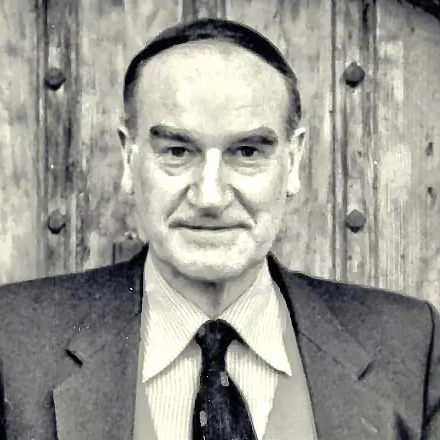
Brian Bond was one of the leading British military historians of the last half century. He was my friend and mentor, and a huge influence on my career. This piece is an extended version of a piece that appeared in the Journal for the Society of Army Historical Research in September 2025. I am indebted to the Journal’s editor, Andrew Cormack.
Professor Brian James Bond died on 2 June 2025 at the age of 89. Born in Marlow on 17 April 1936, he was educated at Sir William Borlase’s Grammar School, Marlow; Worcester College, Oxford; and King’s College London (KCL). Brian was from humble stock. He was a bright boy, and late in life paid tribute to the Butler Education Act of 1944 from which he benefitted. His father was a gardener, and worked in Medmenham, a small village between Marlow and Henley-on-Thames, for Sir Basil Liddell Hart. ‘The Captain’, as the young Brian called him became his mentor. This transformed Brian’s life and set him on the path of becoming an extremely distinguished military historian. After a post at Liverpool University, Brian moved to the fairly recently created KCL Department of War Studies in 1966, retiring in 2001. Brian married Madeleine Carr in 1962. Madeleine and Brian were devoted to each other. After she died in 2023, Brian struggled on bravely, but he missed her deeply. The marriage was childless.
Brian had a considerable hinterland. He loved literature, especially poetry, and sport, particularly football and cricket, pets, and the natural world. A countryman at heart, despite spending most of his working life in London he remained living in Medmenham. The last time I saw him, about three weeks before he died, I asked Brian about his favourite childhood memory. He replied that it was roaming across the countryside with his Irish setters.
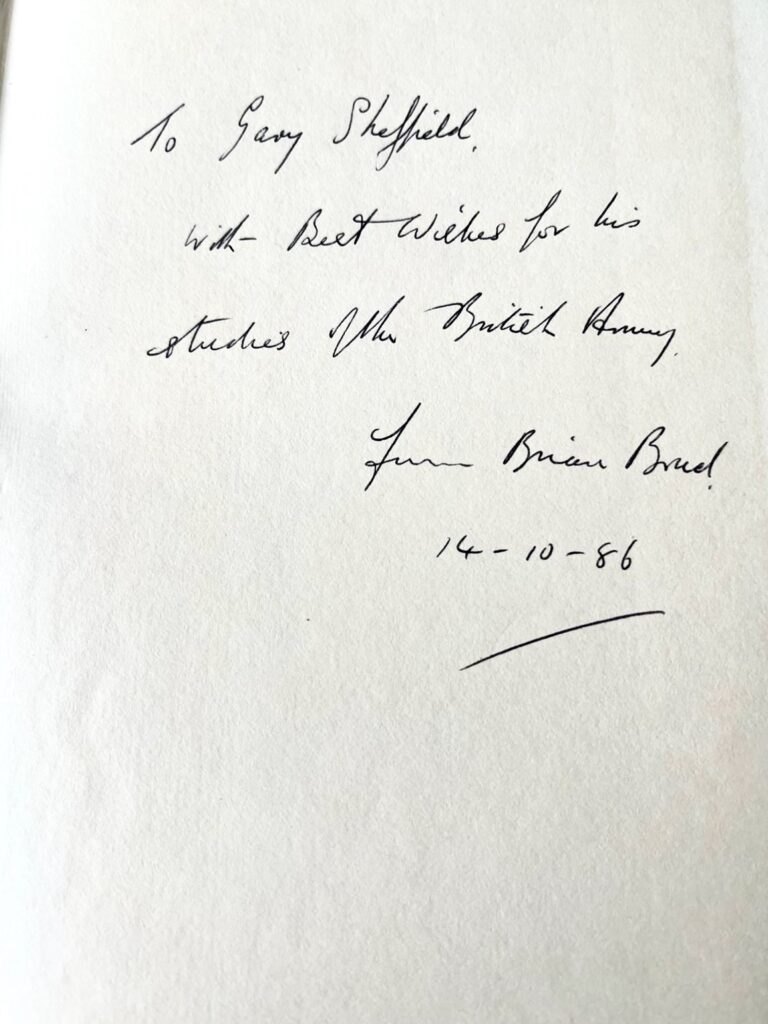
One of the things of which Brian was very proud was having successfully supervised more than 50 PhD students. I was one of them. At the time I started my doctoral research, in 1986 when I was a junior lecturer in the Department of War Studies at the Royal Military Academy Sandhurst, Brian had a reputation as a difficult man and a demanding supervisor, but clearly he was the best scholar to supervise me. So, I went in with my eyes open. At first Brian was a little suspicious of me; there was an unfortunate record of Sandhurst lecturers beginning but not completing theses. However, when I began regularly to submit draft chapters to him, which would be returned with comments in his spidery handwriting, his attitude changed markedly. He realised I was serious about historical study and gaining a PhD. This speaks to Brian’s dislike of students who put in less than 100% of effort, but also his appreciation of those who did – and especially those students who did not require close supervision, but rather a gentle hand on the tiller. I found him a fount of good advice, encouragement and suggestions to improve my work. He punctured my occasional pomposities, and ruthlessly extirpated grammatical howlers. Over the years our relationship developed from pupil and tutor, to junior and senior colleague, and eventually to friends and equals. I valued his friendship greatly. In recent years we would meet every so often for lunch, to reminisce, and to talk about military history – he stayed in touch with developments in the field until the very end.
For many years, Brian chaired the Tuesday evening military history seminar at the Institute of Historical Research at the University of London. He was firm but fair. Students who overran their allotted time were beyond the pale, in part because the seminar had to end in time for him to catch his train home, and more than once I heard him express polite disbelief at some far-fetched theories and opinions. Sometimes he exercised his dry sense of humour. After listening to my re-evaluation of British military police in the First World War, he solemnly asked me if my next project was a rehabilitation of the reputation of traffic wardens! However, Brian would give speakers a fair hearing and sometimes deferred to the expertise of students in the audience.
When Brian became the President of the British Commission for Military History in 1989, he asked me to become the Secretary-General. The BCMH brought together professional scholars, lay historians, and military history buffs, and Brian made a number of friendships with BCMH members. In 2001 he published an important collection of essays that was based on the papers from a BCMH conference, which Brian co-edited with Michael D. Taylor, a BCMH member and non-professional historian (The Battle for France & Flanders: Sixty Years On). Brian was also involved with the Army Records Society, the Liddell Hart Centre for Military Archives and the Western Front Association; and he served on the Council of the Society for Army Historical Research and in 2023 was awarded a Fellowship, which gave him much pleasure. I received my Fellowship at the same time. For me, the honour was increased by the fact that I was in the company of a historian who I had admired for many years and who had supervised my PhD. In this way, Brian’s influence spread out well beyond the usual circle of KCL students.
Some senior academics become resentful or even jealous when their former students or junior colleagues achieve success in the profession. Brian was not numbered among their ranks. He was rightly proud of the number of his former students at King’s who were awarded Chairs or attained other senior positions, published major books or in some other way achieved distinction, even if he sometimes regretted that he did not have more contact with them after they achieved eminence. The long list of Brian’s distinguished former students includes Ian Beckett, Philip Towle, Brian Holden Reid, John Gooch, Keith Simpson, David French, Robert T. Foley, Christina Goulter, Sebastian Cox and Matthew Hughes, to mention but a few. Brian could be extremely generous with his time and counsel to historians who were not his students, as William Philpott, Stephen Badsey, Jeremy Crang and Martin Alexander can testify. Many of the people he championed transitioned to becoming his lifelong friends.
Even if Brian Bond had done nothing else in his career, his nurturing of aspiring scholars would be of note; but of course, he was a prolific and influential writer on military history. Brian possessed two priceless assets for a historian, objectivity and moral courage. His book on the military thought of Basil Liddell Hart, published only six years after the latter’s death, was far from hagiographical. Rather, he gently undermined his mentor’s ‘strategy of the indirect approach’. Much of Brian’s intellectual effort in his later years was concentrated on studying Britain’s role in the First World War, especially the Western Front. He was probably the most senior scholar to embrace the revisionist position of opposition to the ‘lions led by donkeys’ school of thought. Even after more than three decades of patient scholarship, this was very much swimming against the tide. Whoever wrote Brian’s obituary in The Times, a mean-spirited and factually inaccurate piece,took exception to his opinions on Field-Marshal Haig. Actually, Brian’s views on British high command were fairly nuanced (compare them with the more extreme position of John Terraine, who was from a slightly older generation; Brian admired John as a historian) and firmly rooted in scholarship. Brian’s wider perspective on the First World War was that it was not futile or catastrophic, but a war that had to be fought, and was conducted by the British with increasing effectiveness. While this was not a wholly original perspective, and he was generous in admitting his influences, Brian made this distinctly unfashionable argument with consummate skill. His mentor, Captain Liddell Hart, would have been appalled by his mature views – but hopefully he would have applauded Brian’s independence of mind.
Brian Bond authored an impressive series of articles and books on subjects ranging from the Victorian Army to post-1945 military history. He was equally at home with deeply-researched archivally-based monographs such as British Military Policy between the Two World Wars (1980) and survey histories. My personal favourite, The Pursuit of Victory from Napoleon to Saddam Hussein (1996), is a sweeping overview of an important theme that is replete with penetrating insights. Brian also excelled at pithy articles. From Liddell Hart to Joan Littlewood: Studies in British Military History (2015) brings together a collection of his shorter writings. He also edited memoirs and diaries, including Liddell Hart’s contemporary account of his experiences on the Western Front, and the journals of Henry Pownall, the chief of staff to the BEF in the Dunkirk campaign.
Despite his achievements as a historian Brian always lacked self-confidence, and he bruised easily – this was no doubt related to his humble origins as well as his somewhat Eeyore-like personality. He did not achieve the institutional recognition and promotion that he desired. Brian could be grumpy and cranky (he often suffered from back pain), but he mellowed over the years. Sadly, at the end of his life Brian came to believe that his work was being forgotten. I hope his friends and admirers helped to persuade him that he was quite wrong about that. His influence lives on, not least through his former students supervising their own students. There is a loose ‘school’ of military history based around King’s College London and its alumni. Its founder was Sir Michael Howard (perhaps Basil Liddell Hart was its godfather), but Brian was an immensely significant figure in shaping a new generation of military historians. Brian Bond was one of the leading British military historians of the last fifty years. His legacy will continue to influence military history for decades to come.
Gary would like to thank the Reverend Sue Morton, Jeremy Crang and Martin Alexander for their input.