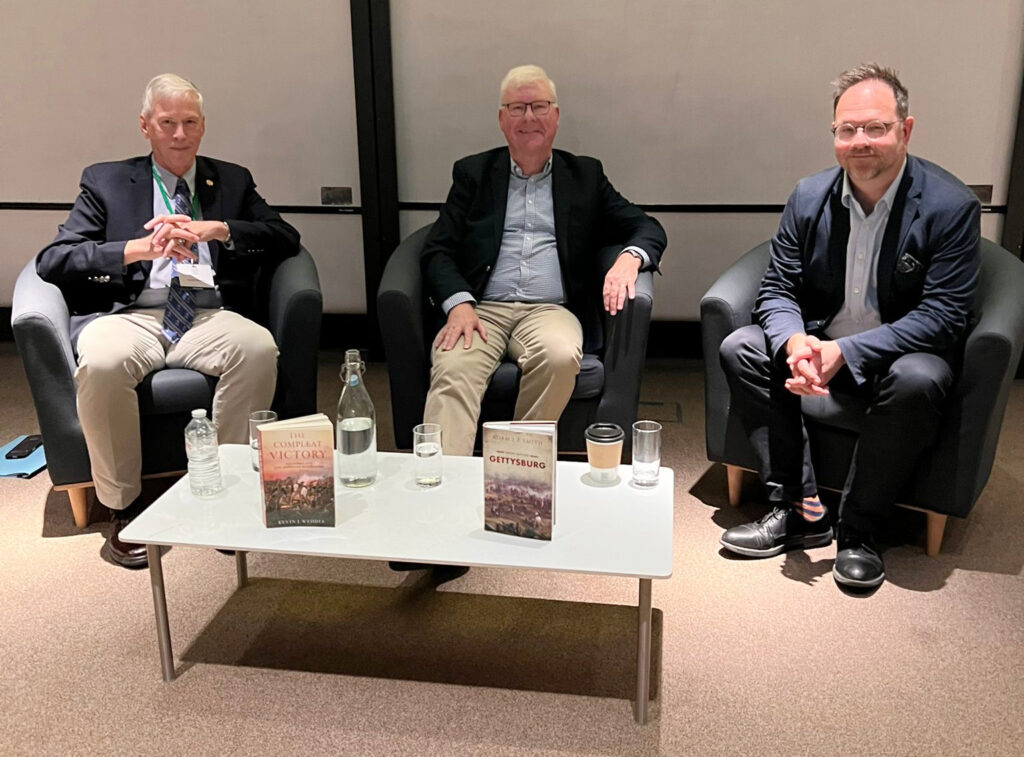
On Sunday 29 March 2026 I was privileged to chair a discussion at the Oxford Literary Festival. I have only appeared at this festival once before, about 20 years ago, when I spoke in the historic and opulent surroundings of Christ Church College. This time I was in a soulless modern lecture theatre in the Maths Institute. Oh well, you win some, you lose some.
The event was a discussion between Kevin J. Weddle and Adam I.P. Smith on their recent books on landmark American battles: Kevin on Saratoga and Adam on Gettysburg. Both books are published by Oxford University Press, and both are excellent, in terms of scholarship and, not least, readability. The chance to discuss two such pivotal events with expert historians was too good to miss.
Kevin, who is a Professor at the US Army War College, has written a splendid piece of scholarship, framed as a narrative account, but infused throughout by sharp analysis. It deals with the campaign as a whole, not just the climatic event. The big takeaway is that British strategy was vastly overambitious, with separate forces advancing over a vast area on widely divergent axes. Of course there were no radios in 1777, making coordination a nightmare. Kevin quoted Field Marshal Montgomery’s concept of the commander’s ‘grip’, which was notably absent in the Saratoga campaign. We didn’t discuss this at the session, but at the time of writing, the successors of the victors of Saratoga are carrying out a badly flawed, ill-thought-out strategy in the Middle East. Strategic principles do not change greatly over time, although the conduct of war does. Five minutes reflection on the strategic lessons from 1777 would not have gone amiss before the war with Iran was launched.
Adam’s book is in the ‘Great Battles’ series, edited by Professor Sir Hew Strachan. Like other volumes in the series, the book is short but ambitious, covering not only strategy and tactics, but also the political and cultural history of Gettysburg. Adam, who is the Edward Orsborn Professor of US Politics & Political History, and the Director of the Rothermere American Institute at Oxford University, modestly disclaims any pretensions to being a military historian (although the military history is pretty impressive!). He presents a masterly discussion of Gettysburg ‘in the round’, explaining why this battle has such a dominant place in the memory of the American Civil War – even though the Union victory at Vicksburg, which took place at exactly the same time, is arguably the more important action in military and strategic terms. Among other things, the symbolism of the defeat of the Confederate Army on Union soil, and President Lincoln’s extremely short but hugely influential Gettysburg Address, delivered on the battlefield a few months later, has made Gettysburg the battle of the Civil War. I have horribly oversimplified Adam’s argument – read his book to get the full story.
We discussed the concept of the ‘decisive battle’. We agreed that a battle does not have to end a war to be decisive. After Saratoga, the American War of Independence dragged on until 1783, and two years of the American Civil War had still to run after Gettysburg. Yet it is difficult to argue that these events were not watersheds, that they changed the course of the wars. In a similar way, we can look at the Somme in 1916, and Stalingrad in 1942, and see them as being similar events in the First and Second World Wars. We also had a fascinating discussion about why Saratoga does not have the same name recognition as Gettysburg – it certainly doesn’t attract the same number of visitors.
It was a pleasure to share the event, steering the conversation, contributing ideas, and occasionally playing devil’s advocate to stir the pot! We had some interesting questions from the audience, and – the mark of a good discussion – when our hour was up we could easily have gone on for longer. My thanks are due to Kevin and Adam, and to Anna Silva of OUP for inviting me to chair the session.
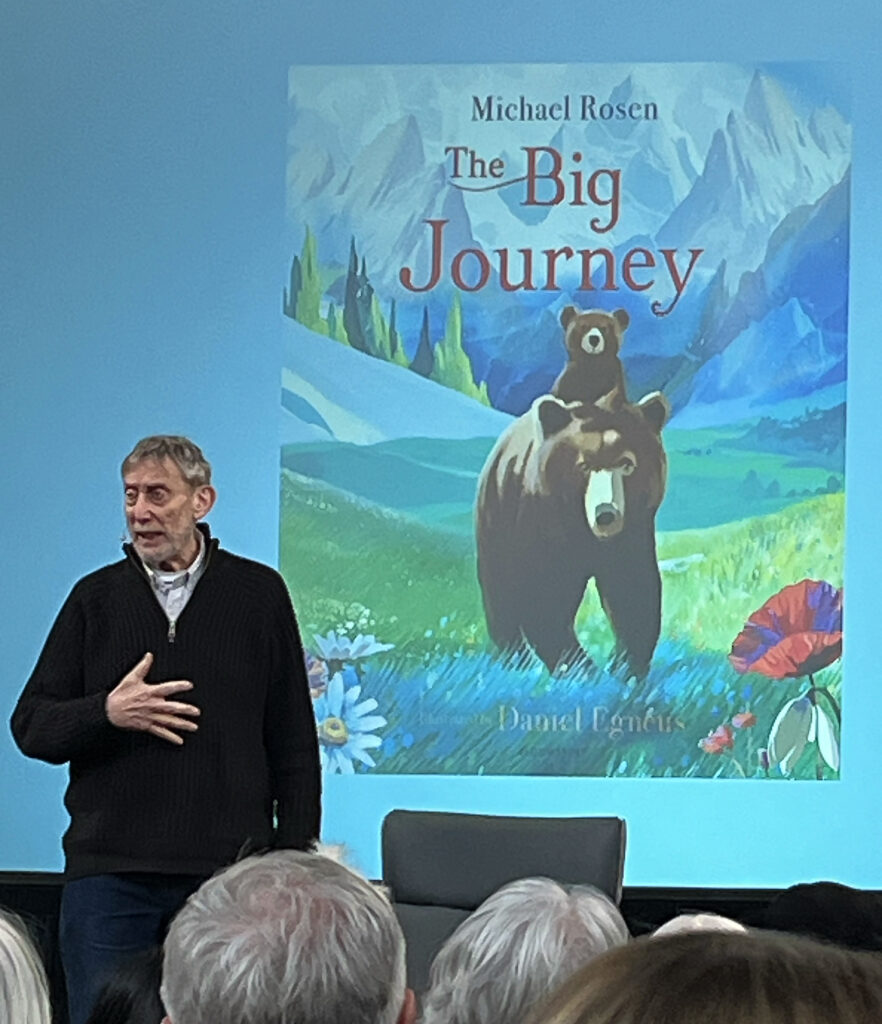
Later that afternoon, my wife having patiently sat through a military history session, we went to hear the children’s author Michael Rosen speak in the Sheldonian. Viv has always been interested in children’s books, and being fairly new grandparents, once again picture books are playing a part in our lives. Michael Rosen was excellent, very funny, and sometimes moving. He gave a talk that appealed to adults and children – no mean achievement. If you ever have the chance to see him in action, seize it with both hands!
Link to The Compleat Victory: Saratoga and the American Revolution
Link to Gettysburg
Link to Oxford Literary Festival